IRVA Book Reviews
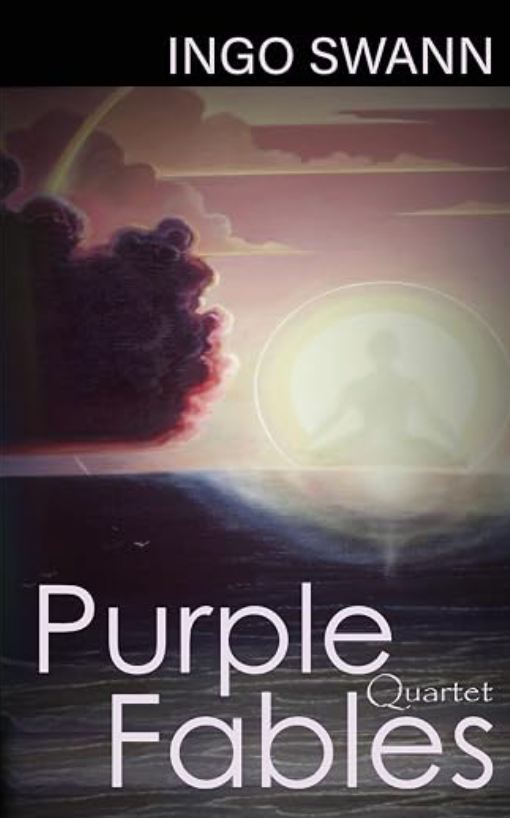
PURPLE FABLES (QUARTET)
By Ingo Swann
Swann-Rider Publications. (Paperback), (1994).
Swann-Ryder Productions LLC. 2015)
INTRODUCTION
Of all Ingo’s books, this is my favorite and I have read this little book several times! Each time I have discovered new insights and understanding of Ingo’s subconscious! Purple Fables gives you an inside glimpse into the matrix that was Ingo!
QUARTET
Ingo relates how Purple Fables came into existence: this was a “data download” (who is to say where they came from: his subconscious, from the Matrix, from a Divine origin?). He woke one morning in April 1993 “out of a dream with the title Purple Fables spontaneously glowing in my consciousness.” He knew there would be four tales, a quartet, which would be written in four days. He even knew how many pages – and the stories unfolded in his consciousness, accompanied by visual images.
For example, the first story The Temple of Sanity, began with the image of a boy reading a newspaper. The story relates how the boy’s grandmother has one wish, to have a space where she could sit and be quiet – a Temple of Sanity - which her son builds for her in the back room of their small shop. Unfortunately, as good intentions sometimes go, the Temple of Sanity becomes anything but!
For his second fable, A Clay Modelling Lesson, Ingo already had “a vague idea” of the tale, meaning to use it in another story. The clay-modelling theme was perhaps based on his foray into L. Ron Hubbard’s Dianetics movement, that some early remote viewing luminaries had explored. And, perhaps, where Ingo and Hal Puthoff’s CRV Stage 6 clay modelling came from?
The second Fable explores the Nature/Nurture dichotomy – genetics or upbringing, which has more effect on human nature? In this story, identical quadruplet boys are born into a poor home and after guidance from a Wise Man, they are sent to live with four families, that represent the major religions of the World. Eventually, the four boys, now grown, travel back to their origins discover each other, and explore their lives.
The third Fable, The Fate and Destiny of a Traveling Clairvoyant, is a short story centered around a young clairvoyant woman who saw “what was happening on the other side of the mountain, and what was happening across seas and oceans too….” Conventional authorities including church representatives quoted scripture that caused her to question her abilities. She shares her predictions with her community, but the natural loss of livestock, the seasonally occurring tornadoes and floods, are then blamed on her insights! Eventually, she decides to build a retreat center, where clairvoyants, such as herself could live, work and share their insights. However, assaults by the scientists and others cause her and her students to realize that “travelling seeing talents were not wanted anywhere, and not in this Modern Age time.”
In the fourth and final Fable, The Watcher of the Purple River, we meet another inspired woman who tries to fit into society Ingo describes how this old woman saw all this through “some kind of misty purple-hued light….” However, he explains that she was born into a time when being clairvoyant was not understood or appreciated and so she became a recluse, living in a small cabin on the side of a river, raising flowers and befriending the local animals and birds.
One day, a young man almost drowns in the Purple River and becomes a student of the very old woman and gradually she shares her wisdom and opens his eyes to a new perspective of life. When he eventually leaves, the Old Woman, reminds him “Now know and understand that the eyes alone cannot see any of these things, and so you must use your other ways and means so as to see then enough.”
Ingo named the source of these Fables as the Sayer of Tales and, as he dedicated Purple Fables to his beloved mother, perhaps they came from her – maybe! Ingo concluded the book by adding a message from the Sayer of Tales “There are places to go and things to see. But your mind’s eyes can see their own tales if you let them – and can see more than tales if you let them also,”