Remote Viewing

Methodologies

Remote Viewing Methodologies - IRVA

Explore the diverse approaches to remote viewing developed over decades of research and training

A Map of Remote Viewing Methodologies

Remote viewing practices have evolved significantly since the early days at the Stanford Research Institute (SRI). As research revealed the promising aspects of remote viewing, structured methodologies were developed to make the skill transferable and teachable. Today, various approaches coexist, each with unique characteristics and applications.

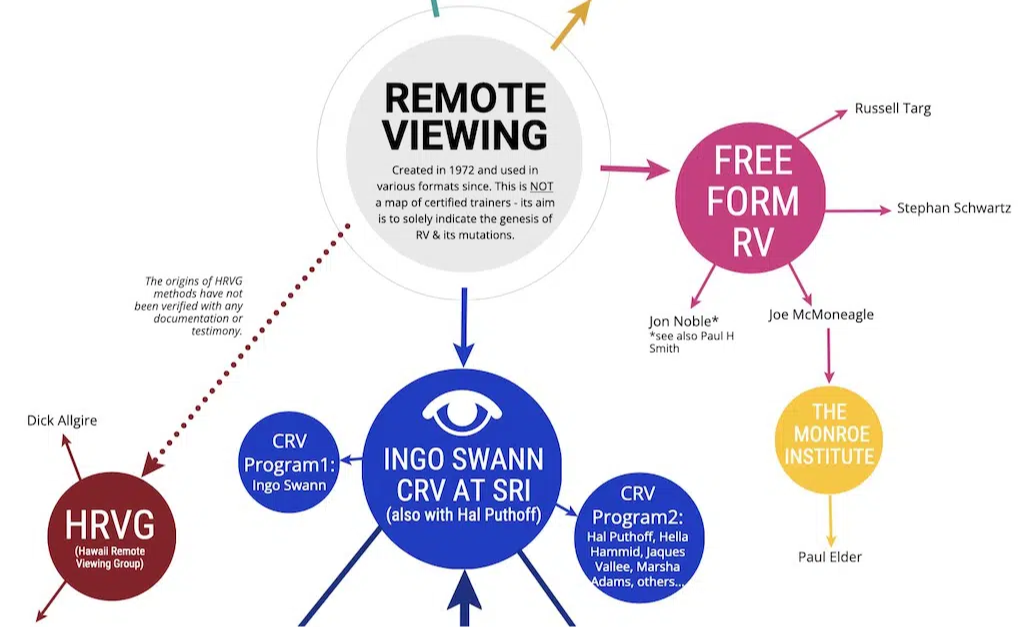
Daz Smith (from remoteviewed.com) has put together a diagram of how the methodologies and key names associated with them are related. The map can also be viewed as a historical view of remote viewing from the early Stanford Research Institute (SRI) period to the proliferation of practitioners after the disclosure of the ‘Star Gate’ program. Click on the image below to see the full map.

IRVA does not endorse any of the names or methodologies depicted below.

Historical Methodology Map

Daz Smith remote viewing methodologies map
📊

Controlled Remote Viewing (CRV)

The most widely known and practiced methodology, originally developed at SRI by Hal Puthoff and Ingo Swann in the mid-to-late 1970s.

Six Stages of CRV:

  • Stage 1: Major gestalt (overall nature)
  • Stage 2: Sensory perceptions
  • Stage 3: Dimensional qualities
  • Stage 4: Complex/abstract perceptions
  • Stage 5: Signal line interrogation
  • Stage 6: Detailed modeling & sketching
🌙

Extended Remote Viewing (ERV)

A relaxed methodology where the viewer reaches a hypnagogic state—the borderline between sleep and wakefulness—to access target information.

Key Features:

  • Darkened, soundproofed environment
  • Monitor guides with questions
  • Longer sessions than CRV
  • Less mental "noise"
  • Hemi-Sync™ audio enhancement optional
🧠

Hawaii Remote Viewers' Guild (HRVG)

A 1980s collaboration between US Army Special Forces and psychic Dr. Richard Ireland, integrating Neuro-Linguistic Programming (NLP) with military SALUTE reporting format.

Unique Features:

  • Beta to Theta wave transition
  • "Blackboard" visual technique
  • NLP facilitation methods
  • Analytical appliqués for evaluation
  • Temporal & location modeling

Natural Remote Viewing (Targ/Schwartz)

A free-style approach based on individual intuitive methods. Used in early SRI research and by practitioners like Russell Targ, Stephan Schwartz, and Joe McMoneagle.

Core Elements:

  • Open questioning protocols
  • Personal format & methods
  • Sketching encouraged
  • All senses engaged
  • Description vs. identification focus
💭

Dream Remote Viewing

Targets are received and explored through the dream state, leveraging natural precognitive phenomena and the suppression of analytical processes.

Process:

  • Set intention before sleep
  • Write target down repeatedly
  • Record dreams immediately upon waking
  • Build recall habit over time
  • Analyze for target correlation
🎯

Associative Remote Viewing (ARV)

Not a method itself, but an application of remote viewing to predict future events with known outcomes (sports, finance, etc.).

How It Works:

  • Each outcome gets associated target
  • Viewer targets future feedback image
  • Analyst compares session to images
  • Closest match = prediction
  • Feedback given after event

Controlled Remote Viewing: The Foundation

Developed beginning in the mid-to-late 1970s through collaboration between Hal Puthoff and Ingo Swann, CRV represents the most systematic and teachable approach to remote viewing.

Core Philosophy

CRV is based on the principle that one does not train someone to be "psychic," but rather teaches a person to "expand the parameters" of their perceptions. The methodology assumes that psychic information is carried to the viewer on a theorized "signal line" which the viewer's subconscious naturally detects.

The Goal: Signal Line to Waking Consciousness

CRV aims to facilitate the transfer of information from the viewer's subconscious, across the threshold of awareness, and into waking consciousness, where it can be "decoded" into an intelligible form. Viewers learn to manage mental "noise" and develop control over the perception transfer process.

Historical Impact

After the government program became public in 1995, the name shifted from "coordinate" to "controlled" remote viewing to reflect the broader aspects of the methodology. CRV was the primary method used to train military personnel and government civilians, and became a major RV methodology employed throughout the government program.

Understanding the Signal Line

The "signal line" is a theoretical construct central to CRV and many other remote viewing methodologies. It represents the proposed mechanism by which psychic information reaches the viewer.

Subconscious Detection

According to CRV theory, the viewer's subconscious mind naturally detects the signal line carrying information about the target. This detection occurs automatically, but accessing the information requires:

  • Relaxed alertness: A state between active thinking and sleep
  • Minimal mental interference: Reducing analytical overlay and noise
  • Proper encoding: Learning to translate subconscious impressions into verbal or written form
  • Structured progression: Following the stages of information deepening

Information Transfer Across Awareness Threshold

The challenge in remote viewing is not receiving information—the subconscious already has it—but rather crossing the "threshold of awareness" to bring it into waking consciousness in a coherent, usable form. This is where the structured stages become essential.

Remote Viewing Applications

Remote viewing methodologies have been applied across diverse domains, from military intelligence to scientific research, archaeology, and personal development.

Military & Intelligence

  • Target location identification and assessment
  • Personnel status and conditions monitoring
  • Equipment and facility descriptions
  • Event prediction and timing

Research & Scientific Inquiry

  • Psi phenomenon investigation
  • Consciousness studies
  • Precognition and temporal perception
  • Replicable experiment design

Modern Applications

  • Archeology: Locating and assessing historical sites
  • Finance (ARV): Predicting market and economic trends
  • Sports (ARV): Forecasting competition outcomes
  • Personal Development: Enhancing intuition and perceptual abilities
  • Wellness: Complementary practice for mindfulness and consciousness exploration

Derivatives & Evolution of CRV

Since the original CRV methodology was developed, various practitioners and schools have created derivatives, each adding their own structure, vocabulary, and emphases.

Technical Remote Viewing (TRV)

An adaptation of CRV that reorganizes some stages and modifies vocabulary, while maintaining the core intent of structured signal line access and information transfer.

Scientific Remote Viewing (SRV)

Another CRV derivative that emphasizes repeatable protocols and analytical rigor, designed to meet scientific standards for controlled, reproducible remote viewing sessions.

Why Derivatives Emerged

  • Accessibility: Different learning styles and prior experience levels
  • Specialization: Adaptation to specific applications (research, prediction, etc.)
  • Cultural differences: Integration of regional practices and philosophies
  • Refinement: Improvements based on accumulated experience and feedback
  • Teaching emphasis: Varying focus on theory, practice, and experimentation

Underlying Intent

Despite structural differences, all derivatives of CRV maintain the same underlying goal: facilitating the transfer of information from the viewer's subconscious into waking consciousness in a structured, controllable, and teachable manner.

Disclaimer: IRVA does not endorse any of the names, methodologies, or practitioners depicted or described on this page. This content is provided for informational and educational purposes to document the historical development and current landscape of remote viewing approaches. Individual practitioners and schools may operate with varying standards, training philosophies, and ethical frameworks.